

SYMBOLISM!
It’s no wonder Cloud Atlas opened to mixed and polarized reviews, it’s like a three-hour, constantly shifting contradiction, going from tear-inducing poignant to chortle-provoking stupid (and you never want to provoke a chortle, EVER). You want to give it credit for all its dazzling imagery, but almost every actual idea it presents it eventually contradicts or pisses down its leg.
Based on the novel by David Mitchell, Cloud Atlas is a sort of Valentine’s Day of Oscar movies, a tale of love across lifetimes. The twist this time is that each vignette stars the same cast – Tom Hanks, Halle Berry, Jim Sturgess, Jim Broadbent, Hugh Grant, Ben Whishaw, Doona Bae, and Hugo Weaving - giving the makeup artists a workout and keeping the producers from having to hire Josh Duhamel. Co-directed by Tom Tykwer and the Wachowski Starship, it cuts between six interconnecting storylines:
- An 1849 colonial ocean voyage (Wachowskis)
- A 1930s gay love story about an aspiring composer (Tykwer)
- An environmental thriller set in 1970s San Francisco (Tykwer)
- A contemporary drama about a British book publisher (Tykwer)
- An Asian-face revolt in 2144 New Seoul (Wachowskis)
- A Hunger Games-ish arrow fight on a post-apocalyptic 24th century forest island (Wachowskis).
Going into a three-hour story of love that defies time, place, and the boundaries of the individual, you dread a certain amount of pomposity, a story drunk on its own loftiness. Even the casual moviegoer recognizes the correlation between make-up and awards-needy self-importance, and Cloud Atlas has enough conspicuous make-up to build Nicole Kidman a thousand nose prosthetics. But at least at first, Cloud Atlas is a pleasant surprise, seeming more concerned with imagery than with beating you over the head with loves, longing, and triumphs of the will. I love a period piece, and Cloud Atlas is like six in one – Downton’s abbey, frigate, restaurant, island, nuclear reactor, and nursing home.
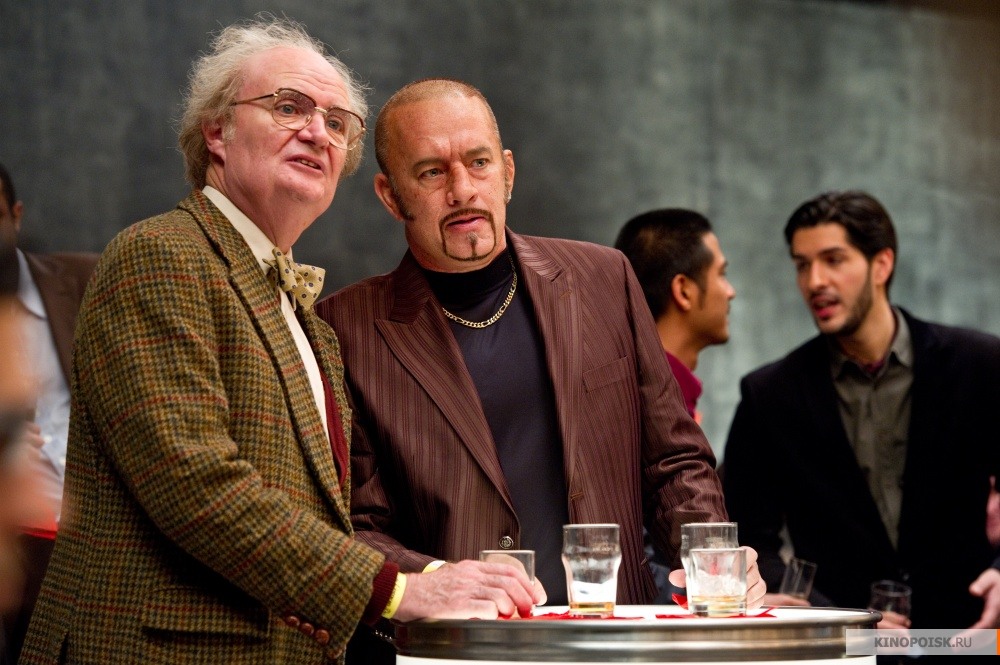
Though nicely playful, the storylines do vary, quality-wise. For a guy with two Best Actor Oscars, Tom Hanks’ British accent is surprisingly terrible in the story of the Chopper-esque author of “Knuckle Sandwich.” The flip side of that coin is the post-apocalyptic forest island of Ewok people who sippy tie a yibbity yup in a future-bumpkin patois more than a little reminiscent of Grotesco’s “The Trial.” Makin’ ‘cusations against a spesh guest, it jus’ ain’t politesome, Zachry. Most future movies just go with a vaguely-English, overly-earnest toolspeak, but invented vernacular like this is so, so much more fun.
Point being, the storylines all start out strong, drawing you in with pretty pictures and goofy makeup. It’s hard (and confusing) to buy Halle Berry as a blue-eyed blonde Englishwoman or Jim Sturgess as a Korean, you figure they’re going somewhere with it, and all the costumes and sets are so fully realized that you’re happy to just float along with the stories, shifting gears before getting too bogged down in any one narrative.
And then, eventually, it all crashes and burns.
It’s flattering to the filmmakers to think Cloud Atlas‘s mixed reviews are the result of “challenging” or “provocative art,” but the cringe-worthy Asianface makeup isn’t a difficult idea so much as uncanny valley unpleasantness, a basic lack of finesse that eventually reveals itself in every storyline. You’d question the taste of anyone who thought this was a good idea, wouldn’t you?

GAAAAH, KILL IT WITH FIRE!
“Too ambitious” gives you the impression of a movie that tries to be bigger than it was meant to be and ends up muddled – the ending of Fight Club comes to mind, a story broadened when it should’ve stayed narrow. If anything, Cloud Atlas is the opposite, facile and falsely reductive, slapping sloppy, crappy genre endings on all of its intriguing storylines. It’s entertaining for the vast majority of its running time, but the ending is so stupid that it almost makes you feel like a jackass for having enjoyed it to begin with.
One story has a greedy oil man straight out of the Muppet movie. Another climaxes with a bad guy who helpfully explains his evil plans right before he’s about to kill the hero. At least three of them have that Scooby Doo moment where the bad guy has the good guy in his gun sights when all of a sudden the good guy’s friend comes out of nowhere and kabongs the bad guy with a big ol’ wrench. All it’s missing are the little birdies flying around the heads. Oh, and the bad guys all toss around racial slurs, in case you were confused about whether they were bad or not.

Worst of all, the initial playfulness gives way to vacuous preaching as soon as they start trying to tie up loose ends. ”Our lives are not our own. From Womb to Tomb we are bound to others. Every crime and kindness births our future,” is a frequent refrain, and yeesh, guys, show, don’t tell. Cloud Atlas‘s humanist ideas about reincarnation, all races are one, love transcending lifetimes, everything is connected and freee looove, braaah are fine as a jumping off point into the individual worlds, which are brilliantly realized, but the more they try to sell you on the interconnectedness of it all, the more the seams start to show.
For one thing, this humanist story about the illusion of individuality sure is pretty goddamn Judeo-Christian at times. If you want to go all krishna krishna hare hare with whites playing Asians, blacks playing whites, and Maoris that are black (?) to show that we’re all one love, mon, how come Hugo Weaving is the bad guy in every world? Aren’t there not supposed to be demons in humanist reincarnation land? And if the whole premise of the enterprise is timelessness, loves that live on and ends that are never really the end, why are you trying to wrap up every storyline in a neat, little Hollywood package? (To say nothing of why every story seems to have chase scene and shootout).
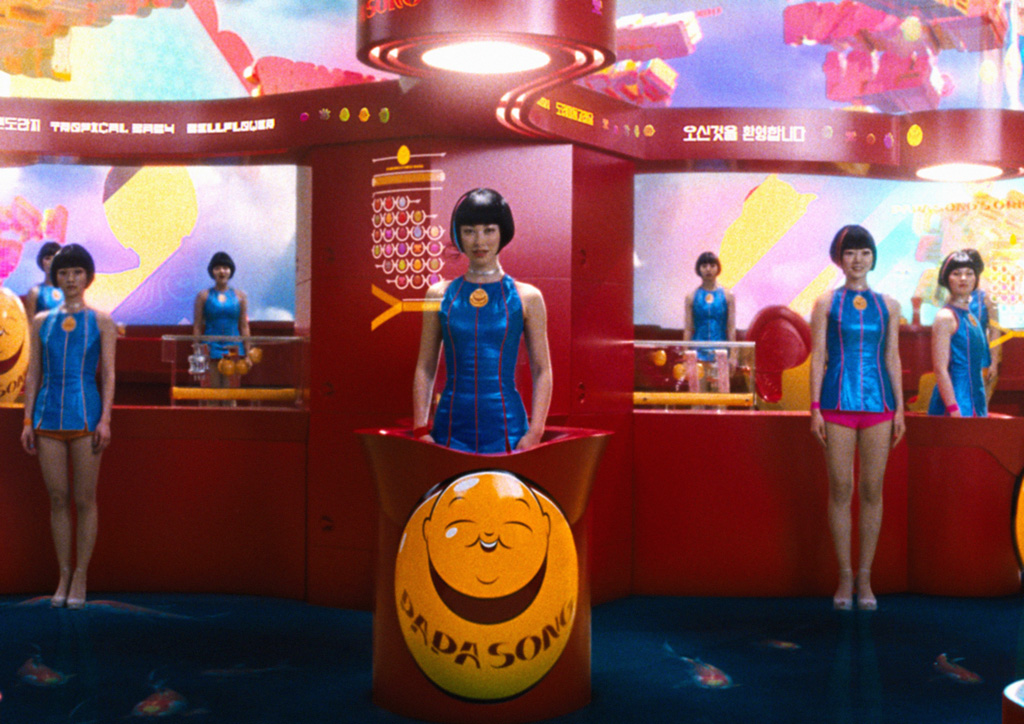
By the end, Cloud Atlas feels like the college freshman full of ideas who grows dreadlocks to keep from bein’ a stuffed suit stuck in a cookie-cutter world like his conformist dad, but can’t quite commit to Bohemianism enough to give up his trustfund. In the Korean restaurant storyline, where genetically-engineered waitresses work a future-Hooters with digital koi swimming across the floor and sleep in storage coffins (probably the most visually inventive of the storylines), there’s even a lingering, spread-armed, messiah-like death pose in one scene. REALLY?! A F*CKING CHRIST METAPHOR?!? YOUR HUMANIST STORY OF REINCARNATION HAS A F*CKING CHRIST METAPHOR?!?
It reminded me of The Matrix trilogy, where the Wachowskis started out with an intriguing concept and ended it on “Hey, do you get it? Neo is Jesus. Also, the future is dreadlock rave parties.”
Christ metaphors are the absolute lowest-hanging fruit of faux-meaningful symbolism, like posing a naked chick next to a crucifix. “Ooh, don’t buy Madonna’s perfume, you guys, she’s dangerous!” It’s not edgy anymore! Also, there are other books! Cloud Atlas has so many allusions to other things – Soylent Green in particular – and weird, self-referential meta art, like characters from one storyline showing up in TV shows in others – and concurrently, such a failure to flesh out its own ideas, that you start to wonder if Cloud Atlas is overstuffed simply as a way to compensate for not really having much to say in the first place. The old post-modern parlor trick – stuff piled on stuff piled on stuff eventually revealing… ta da! We got you to dig through a pile of stuff! Get it, man? The journey was the destination.
Look, I don’t know what the hell grade to give this movie. It’s a very entertaining movie that looks great and is occasionally touching, almost in spite of itself. It’s 90 percent good, and yet so, so bad.
GRADE C+


This is actually good news. I can’t sit thru a 3-hour movie anyway, so I’ll get up and leave after about two hours. That way I’ll get to see all the good parts and not be disappointed by the ending.
It sounds like everything that was subtle in the books is made SUPER BOLD ALL CAPS in the movie. And there’s more romance and action scenes. So, basically, they Hollywooded it.
Also, I hate that the crappy yellowface make-up is used in what was my favorite part of the novel.
But I’m still gonna’ see it.
cLOUD FARTlas smells like Southland Fails 2.
Oh. Oh. Careful where you wave that butterknife-sharp wit. You might hurt someone. Probably yourself.
That white Korean guy up there was just the Wachowskis way of still having Hugo Weaving in the movie.
To their credit, Hugo Weaving makes everything better. Even “Korea”, whatever the fuck that is.
Yeah, but, Hugo’s already pretty weird looking as is without the Asianface makeup. For a director to mar him up like that is akin to GG Allin taking a shit on stage. They’re just doing it for the shock value.
Now V for Vendetta… that was a good movie.
Okay, this is the best fucking review of CLOUD ATLAS yet. Completely correct on all counts.
“Makin’ ‘cusations against a spesh guest, it jus’ ain’t politesome”
Did Karl Welzein get a writing credit?
This is a pretty fair and accurate review. Personally, I actually enjoyed the ending more than the rest of the movie. Maybe it was because I spent too much time trying to connect the dots throughout the movie.
That being said, the visuals were pretty. The score was fantastic. I think I would enjoy it even more after watching it a second time, going into it knowing what to expect regarding the plot.
Oh yeah, Tom Hanks should never do a cockney accent. EVER.
Was he up there with Dick Van Dyke in the Bad Cockney Accents Hall of Fame?
Imagine Vince, pretending to be The Stath, writing Tom Hanks’ dialogue.
Eddie, you shut your dirty whore mouth. I don’t care what he claimed on the Mary Poppins DVD extras, his is the only cock, er, cockney I want
But he didn’t have a horrible cockney accent. He had a horrible Irish accent.
…the character is cockney.
Irish. His name was Dermot, which is a common Irish name, and his brothers were Irish. I know a lot of people get British and Irish confused, but when you’re born and raised there, it’s easier to hear the differences.
…so long as we’re speaking of the same character. I’m referring to the author character Hanks played, and not the British doctor on the ship.
triumphs of the will. I love a period piece
Taken out of context, this would imply Vince is a big fan of Leni Riefenstahl.
It looks like the kind of rental you’d pause for breaks a bunch of times. “Oops, forgot to check the dryer!”
“….but can’t quite commit to Bohemianism enough to give up his trustfund.” I <3 you Vince Mancini (no homo, brah). As far as the grade goes, just do what Ebert does when shiny things turn off his analytical mind. FOUR STARS!!!!!
Or just do what Vince Mancini does. If you can’t understand a movie after the first viewing, shut down, refuse to engage the film in an intellectually honest way and declare that “it sux.” Don’t forget to spend more than half of the review complaining about how “shallow” and “pretentius” the film is. Snarking is one thing, but when you waste most of the review trying to prove how much smarter you are than the filmmakers it becomes distracting. I almost spit out my soda laughing when this guy accused the directors of perpetuating “the old post-modern parlor trick”!
What kind of soda was it? Was it Dr. Pepper? I’m seriously curious.
It’s called “Postmodern Dew” It’s when evil beverage companies mix a bunch of old flat sodas together to trick idiots into thinking they’re drinking something fresh and original.
Is Hugo Weaving supposed to look like Spock?
Since when does Humanism have anything to do with reincarnation?
Hey Vince,
Great review. Agreed with you on all accounts aside from one… Tom Hanks as the author didn’t have a terrible British accent, but rather a terrible Irish accent. There’s nothing worse than hearing someone butcher our accent.
Wow, it’s clear that the reviewer didn’t “get” this movie- or the Matrix Trilogy for that matter. He misses all but the most obvious symbolic structures in both narratives(The Christ metaphors) and then rails against the directors for including “only” those “low-hanging” Christ metaphors. Forget the fact that the Messiah analogies were only icing on top of much deeper philosophical themes including references to everything from Advaita Vedanta to Baudrillard to Schopenhauer. He didn’t notice any of that stuff so it doesn’t count! The only themes that count are the parts HE noticed, which are OF COURSE the small nuggets of Christian symbolism which are deliberately obvious and serve as anchors for casual viewers(like Vince) who don’t have any interest in rewatching the films and/or don’t have the background to get the references to say, Nietzschean eternal recurrence or cultural hyperreality.
Do the small nuggets of Christian symbolism come with the soda you were drinking earlier?
You put icing on themes?
Christian Nuggets taste so good that no one stops to wonder what part of Christ they’re made out of.
My takeaway from this review is that CA is like Ras Trent. I like Ras Trent so…
So Genki Sudo came up with the idea for the movie?
I found the parts directed by Twyker held up better than those directed by the Wachowskis. Almost like Twyker was better able to find the human elements of the meditations on love, freedom and humanism in the parts he directed, while the Wachowskis were so in love with the idea of humanism that it was more important to talk about the idea than show it.
I loved that Hanks was able to play both so totally within type, and also totally against it. Bad accent or no, that author may have been the least Tom Hanksy character of all time.
Why is a movie set in a nursing home a period piece? I dunno if I missed something, but that line kind of made me chuckle. Is it like a Victorian nursing home?
Your review reminds me of what Tim Cavendish said, “what is a critic, but one who reads quickly, arrogantly, but never wisely”
Sure, there could be plenty of things one could make fun of in Cloud Atlas, if one did not understand why they were happening and since you revealed in your review you felt all the endings didn’t work shows that you really didn’t follow the simple connections that sewed together the 6 stories that, at first glance seemed so different from each other, which of course was the point of having 6 completely different stories. You see, no matter what the story and no matte who the players, the outcomes will always weigh the same, with winners & losers; each person with choices in front of them. It’s the central theme to almost every film ever made; choices.
I see people complain so much about a 3 hour film and how that’s such a hurdle, including you, but with 6 stories being told that would only average 30 minutes per story, each having to give a start, middle and conclusion in that 30 minute time, so really, is 3 hours too long for a piece like this? My personal opinion is a film should be as long as it wants, as long as it’s interesting, but then again I like watching films.
To borrow one of your quotes “It’s hard (and confusing) to buy Halle Berry as a blue-eyed blonde Englishwoman” well, actually it’s quite simple if you understand why each actor took on several parts, but it looks like you decided to entertain your readers instead of understanding what you were reviewing and for that I say well done. I really though Berry was one very hot blue-eyed blonde Englishwoman! and she also did a great job as a male Korean doctor.
That one paragraph where you mention a muppet movie is classic. It shows you had no idea what you were watching. oil man? Are you referring to the Hugh Grant character who runs the Nuclear Power Plant? Wow. it must really suck when you watch a film, know you have to review it, but really had no idea what you just saw.
It’s so funny to read reviews from people who didn’t get it.
“future Hooters”! Now, that’s humor!
Maybe next time you’ll pay closer attention to your job.
Right, oil man. I was referring to the oil lobbyists trying to kill Halle Berry who were setting up the nuclear plant to fail in order to turn public opinion away from nuclear. Or did you miss that part? Sounds like your mind was so occupied with the book that you might have missed some of what actually made it onto the screen in the movie, which is what I was reviewing (at least, judging by you quoting one of the characters in your attempt at a diss).
You also seem to think my criticism was about not understanding that the seemingly different stories were actually so similar. Oh no, I got that. My objection was more due to the way each storyline seemed to end with a bad guy having a good guy in his gun sights, and then suddenly getting kabonked on the head like a cartoon. And that has nothing to do with “choices,” unless you count bad screenwriting choices. Again, if you were so wrapped up in the book that you weren’t really watching, you might have missed it.